Disclaimer: This article presents historical facts alongside speculative analysis. Connections drawn between JFK's assassination and Israeli nuclear policy remain unproven and controversial.
The Historical Record: Kennedy vs. The Bomb
Kennedy's Unprecedented Pressure Campaign
Between 1961 and 1963, President John F. Kennedy engaged in what declassified documents reveal to be an increasingly tense confrontation with Israeli leadership over the Dimona nuclear facility in the Negev Desert.
The documented timeline:
- 1960-1961: U.S. intelligence confirms Israel is building a nuclear reactor at Dimona, far more sophisticated than publicly claimed
- May 1961: Kennedy sends his first letter to Prime Minister David Ben-Gurion requesting information and inspections
- Multiple follow-ups: Kennedy sent at least eight letters, each more forceful than the last
- July 1963 letter (one of the most aggressive): Kennedy wrote to new PM Levi Eshkol, threatening to reconsider the entire U.S.-Israel relationship if regular inspections weren't permitted
Kennedy wrote: "This Government's commitment to and support of Israel could be seriously jeopardized if it should be thought that we were unable to obtain reliable information on a subject as vital to peace as the question of Israel's effort in the nuclear field."
The inspections that weren't:
The U.S. did conduct visits to Dimona (1961-1963), but these were carefully choreographed:
- Visits were announced well in advance
- Israeli officials controlled which areas inspectors could access
- Some rooms were reportedly bricked over temporarily
- Scientists could only examine what was shown to them
- No sampling of materials was permitted
American inspectors suspected deception but couldn't prove it definitively.
The Abrupt End
November 22, 1963: Kennedy is assassinated in Dallas.
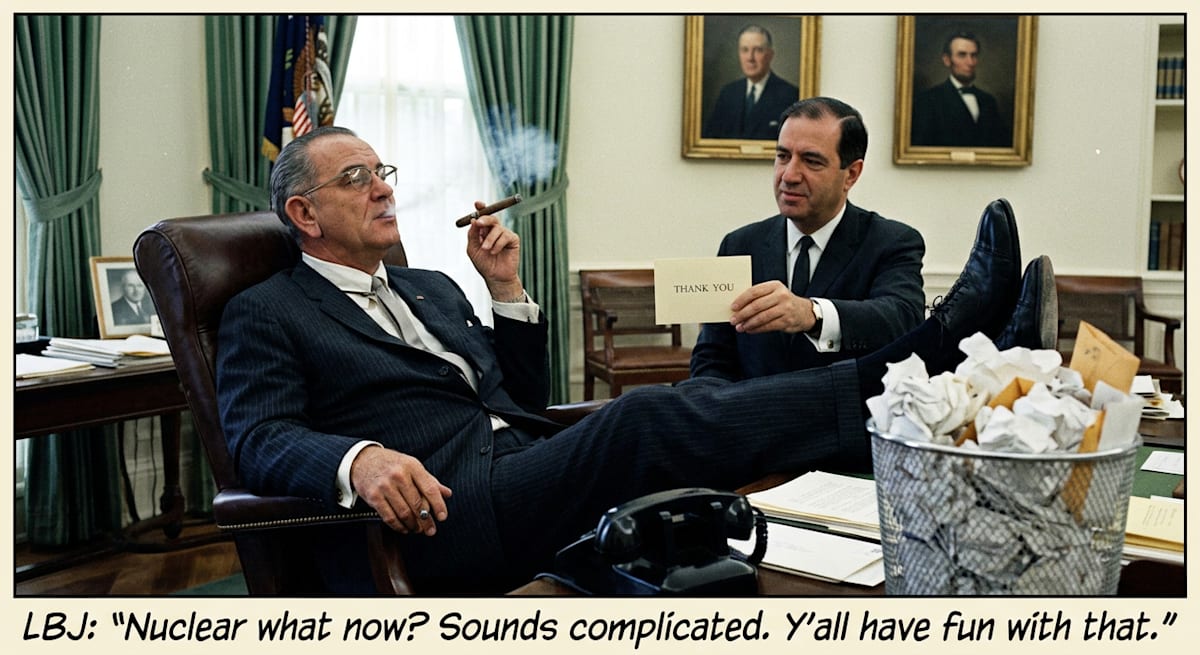
What changed under LBJ:
The pressure on Israel regarding nuclear weapons essentially evaporated:
- Inspection visits became rarer and less rigorous
- No more threatening letters about the bilateral relationship
- 1965-1966: Last U.S. inspections of Dimona; program continues
- By 1967: CIA estimates Israel has a nuclear weapon
- LBJ's approach: "Don't ask, don't tell" - as long as Israel didn't test the weapons, the U.S. wouldn't push back
Johnson's relationship with Israel was notably warmer:
- Increased military aid significantly
- Supported Israel strongly during the 1967 Six-Day War
- Personal relationships with the Israeli leadership were friendly
- His advisory team included strong Israel supporters
The Questions This Raises
For conspiracy theorists, the timeline is suggestive:
Kennedy applies maximum pressure → Kennedy is assassinated → Pressure disappears → Israel gets the bomb
But correlation isn't causation. Let's examine what we actually know.
The Hoover Factor: Controlling the Investigation
FBI Director J. Edgar Hoover's role adds another layer of intrigue.
Hoover-Kennedy Tensions (Documented)
Personal animosity:
- Hoover had served since 1924 and operated the FBI like a personal fiefdom
- He compiled dossiers on politicians, including compromising information on JFK's affairs
- Judith Campbell Exner affair: JFK had a relationship with a woman who also knew mobster Sam Giancana—Hoover knew this
- Robert Kennedy (Attorney General) wanted Hoover to retire; Hoover resented the Kennedy brothers
The investigation:
- Hoover declared Oswald the lone gunman within hours of the assassination
- FBI memo from November 24, 1963 (before Oswald was even killed) stated the Bureau would issue a report establishing Oswald acted alone
- Hoover opposed the Warren Commission, preferring the FBI's conclusion to stand without further investigation
- When the Commission was formed, anyway, Hoover provided information selectively
Speculative Connections
Could Hoover have had foreknowledge?
- No evidence suggests this
- However, his rush to close the case prevented a thorough investigation of alternative theories
- His control of information flow meant certain leads weren't pursued
Hoover's own interests:
- He wanted to protect the FBI's reputation (missing Oswald as a threat was embarrassing)
- He had no love for the Kennedys personally
- A complex conspiracy investigation would be messy and might expose FBI failures
Other Presidents and Israeli Nukes
The "Don't Ask, Don't Tell" Consensus
Lyndon Johnson (1963-1969):
- Essentially, he allowed Israel to proceed
- 1968: Israel likely achieved nuclear capability under his watch
- No consequences, no public acknowledgment
Richard Nixon (1969-1974):
- 1969: The Meir-Nixon meeting established an unofficial understanding
- Israel wouldn't test or declare; the U.S. wouldn't press the issue
- September 1979: Vela Incident (suspected Israeli nuclear test) was officially deemed "ambiguous."
Every President Since:
- Maintained "nuclear ambiguity" policy
- Israel has never officially confirmed possessing nuclear weapons
- U.S. has never officially acknowledged it (though intelligence estimates have)
- Israel is estimated to have 80-400 nuclear warheads today
Why JFK Was Different
Kennedy was the only U.S. president to aggressively oppose Israeli nuclear weapons development. Every successor acquiesced to varying degrees.
Why was Kennedy unique?
- Nuclear proliferation concerns: Kennedy genuinely feared that nuclear proliferation would increase the risk of war
- Middle East stability: Believed Arab states would seek their own weapons if Israel got them
- Timing: Israel's program was early enough to potentially stop
- Personal conviction: Kennedy had strong non-proliferation views overall
The Conspiracy Theory Framework
The "Multiple Enemies" Theory
Conspiracy researchers point to Kennedy having antagonized several powerful groups:
- Israeli nuclear hawks - threatened their existential security project
- Military-industrial complex - considered withdrawing from Vietnam (disputed)
- CIA - after the Bay of Pigs disaster, distrusted the intelligence community
- Organized crime - RFK's aggressive prosecutions
- Federal Reserve interests - Executive Order 11110 (alternative currency theory)
- Anti-Castro Cubans - felt betrayed after the Bay of Pigs
The theory: With so many powerful enemies, a convergence of interests might have formed.
What We Can Say With Confidence
Facts:
- JFK uniquely pressured Israel on nuclear weapons
- This pressure ended immediately after his death
- Israel developed nuclear weapons, with no subsequent U.S. president seriously opposing it
- Hoover rushed to a lone gunman conclusion
- LBJ had a dramatically different Israel policy
Speculation:
- Whether these facts are connected causally
- Whether any coordination existed between Kennedy's various opponents
- Whether Hoover's quick conclusion was merely incompetence or something more
What history shows:
- Policy on Israel's nuclear program changed 180 degrees after Dallas
- The brief window where it might have been stopped closed permanently
- Israel became a nuclear power, exactly what Kennedy feared
Conclusion: History's Unanswered Questions
Did JFK's opposition to Israeli nuclear weapons contribute to his assassination? The available evidence doesn't support this conclusion.
However, the dramatic policy reversal after his death remains historically significant. Whether through conspiracy or simply changed priorities, Israel's path to nuclear weapons became unobstructed once Kennedy was gone.
For researchers and readers, the lesson may be this: sometimes the most important historical questions aren't "who did it?" but rather "who benefited?" and "what changed?"
The facts show clearly who benefited from Kennedy's death regarding this specific issue. Whether that's coincidence or conspiracy remains, perhaps permanently, in the realm of speculation.
Sources for Further Research:
- Avner Cohen, "Israel and the Bomb" (Columbia University Press)
- Seymour Hersh, "The Samson Option"
- JFK Presidential Library - declassified correspondence with Israeli leadership
- Warren Commission Report
- FOIA releases on FBI assassination investigation
- National Security Archive - Middle East nuclear documents