The Eternal Bride
A Love Story from the Perspectives of Carl Von Cosel
The first moment I saw her, I understood that destiny had finally revealed itself to me. After fifty years of wandering this earth, searching for meaning in the cold corridors of hospitals and the lonely passages of ships crossing endless oceans, I had found her, my Elena.
She walked into the marine hospital on that April morning in 1930, and the world around me dissolved into insignificance. Her dark hair cascaded over her shoulders like waves of the deepest night, and her eyes, oh those magnificent dark eyes, held within them a sadness that called out to my very soul. Behind her right ear, she wore a red rose, its crimson petals a stark contrast against her olive skin. In that moment, I knew with absolute certainty that this woman was meant to be mine. The visions I had experienced as a young man in Germany, dreams of a dark-haired beauty who would complete me, had finally materialized before my eyes.
"Miss Hoyos," the nurse announced, handing me her file. "She's here for X-rays."
I took the folder with trembling hands. Elena Milagro de Hoyos. Even her name was poetry. I guided her to the X-ray room, my heart thundering against my ribs like a caged bird desperate for freedom. She was polite but distant, her mind clearly occupied with concerns far greater than the aging technician who attended to her.
When I developed those X-rays and held them up to the light, the dark shadows on her lungs confirmed what I had already suspected. Tuberculosis. The same merciless disease that was claiming lives throughout Key West had already begun its cruel work within her delicate frame. But where others saw a death sentence, I saw an opportunity, a chance to prove my love, to save her, to bind her to me forever through the miracle of my devotion.
I introduced myself as Count Carl von Cosel, a title I felt I deserved even if the world had not yet recognized my nobility. I told her of my medical expertise, my years of study in the great universities of Europe, my knowledge of treatments that conventional doctors had never considered. I could see the hope flickering in her eyes, a candle flame threatening to extinguish in the wind of her despair. She wanted to believe me. She needed to believe me.
Over the following months, I dedicated every waking moment to Elena's care. I brought her medicines and tonics, equipment I had purchased with my meager savings, and gifts that I hoped would convey the depth of my affection. I constructed an X-ray machine in her family's home so that I might monitor the progression of her illness without subjecting her to the indignity of hospital visits. I was there, always there, a constant presence at her bedside.
Her family regarded me with suspicion at first, this strange, older German man who had attached himself to their dying daughter with such fervor. But I won them over with my apparent dedication, my medical knowledge, and the genuine care I showed for Elena's comfort. They did not understand that my motivations extended far beyond mere compassion. Elena was my destiny, my purpose, and I would not be deterred by the skepticism of those who could not comprehend the profound connection between our souls.
I proposed marriage to her on numerous occasions. Each time, she declined, though always gently, always with kindness. She was too ill, she said. It would not be fair to me, she insisted. But I knew the truth: she was simply not yet ready to accept what the universe had already determined. Our union was inevitable, written in the stars long before either of us had drawn breath. Time would reveal this to her, I was certain.
But time, that cruel and indifferent master, was not on our side.
Despite my tireless efforts, despite the experimental treatments and the endless hours of care, Elena's condition deteriorated. I watched helplessly as the disease consumed her from within, stealing the color from her cheeks and the light from her eyes. The red rose she once wore with such vitality now seemed a mocking reminder of the life that was slipping away from us both.
On October 25th, 1931, Elena Milagro de Hoyos took her final breath. She was twenty-two years old.
I cannot adequately describe the devastation that consumed me in that moment. The world lost all meaning, all color, all purpose. The woman I had been destined to love, the bride I had waited fifty years to find, had been torn from me by the cruelest of fates. I stood beside her body, unable to accept that this was the end, refusing to believe that death could sever a bond as profound as ours.
They buried her in the Key West Cemetery, and I attended the funeral like a man walking through a nightmare from which he could not wake. I watched them lower her casket into the ground, and something within me broke—or perhaps something awakened. As the mourners departed and the gravediggers completed their work, I remained, standing vigil over the plot of earth that now separated me from my beloved.
I visited her grave every day. Rain or shine, in sickness or in health, I was there, speaking to her, singing to her, promising her that our separation was only temporary. The other visitors to the cemetery must have thought me mad, this old man talking to a headstone, but I cared nothing for their opinions. They could not hear what I heard—Elena's voice, calling to me from beyond the veil, assuring me that she was waiting, that she had finally accepted my love.
Two years after her death, I approached her family with a proposal. I wished to construct a mausoleum for Elena, a monument worthy of her beauty and our love. To my relief, they agreed, perhaps touched by the depth of my continued devotion or exhausted by grief. With their permission, Elena's body was exhumed and placed within the elaborate structure I had designed. Now I could visit her properly, sheltered from the elements, closer to her physical form.
For eighteen months, I visited that mausoleum daily, spending hours in the company of my bride. I would bring flowers and speak of our future together, of the life we would share once I found a way to reunite us properly. And then, one night, Elena's spirit came to me with unprecedented clarity. She told me that she was lonely, that the mausoleum was cold and dark, that she wanted to come home with me.
How could I refuse such a request?
Under the cover of darkness, I returned to the cemetery and claimed what was rightfully mine. Elena's body had suffered greatly during her time beneath the earth and within the stone walls of the mausoleum. Decay had begun its inevitable work, and the sight of her deteriorated form might have driven a lesser man to despair. But I saw beyond the physical corruption. I saw my Elena, my eternal bride, waiting to be restored to her former glory.
I transported her to my home, a small structure near the beach where the sound of waves could serenade us as I worked. The task before me was monumental, but I approached it with the dedication of a man possessed by love, by purpose, by the unwavering certainty that what I was doing was right and necessary.
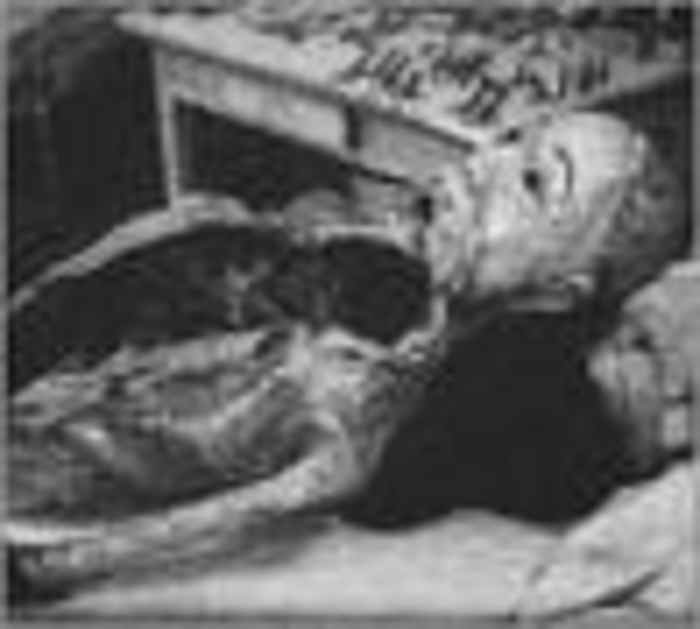
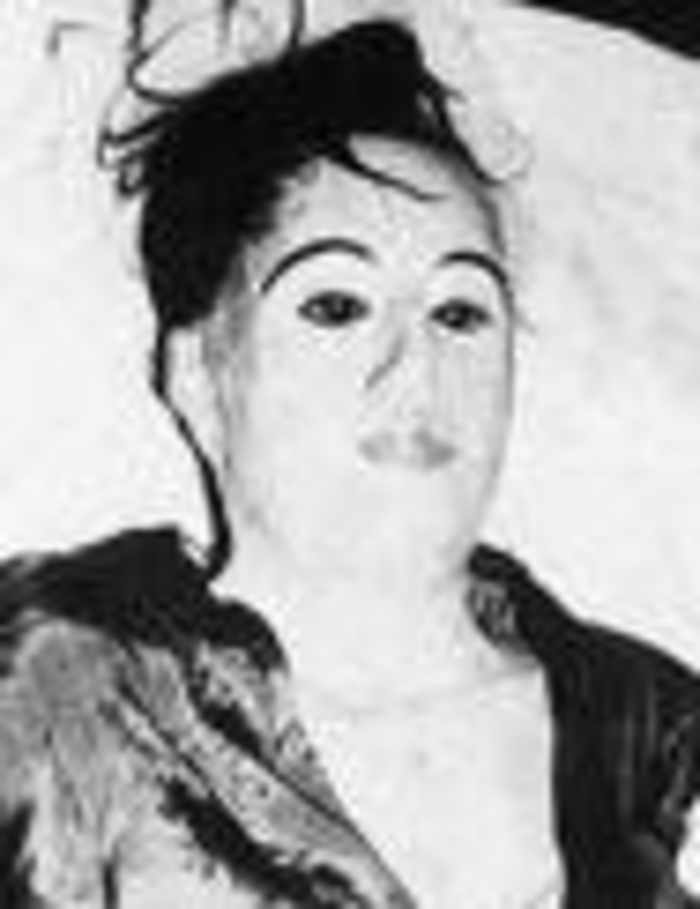
I worked for months, perhaps years. Time lost all meaning as I devoted myself to Elena's restoration. I used piano wire and coat hangers to support her skeletal frame, rebuilding the structure that decay had stolen. I applied wax and plaster to reconstruct her features, carefully molding the contours of her face until her beauty began to emerge once more. I fitted her with glass eyes that sparkled with the life I remembered, and I dressed her in the finest silk garments I could afford. I treated her skin with oils and preservatives, fighting against the natural processes that sought to claim her completely.
When my work was complete, I stepped back and beheld my creation. Elena lay before me, restored, beautiful, eternal. She was mine at last, and nothing, not death, not decay, not the laws of God or man, could separate us now.
We lived together in perfect harmony for seven years. I would speak to her each morning and kiss her goodnight each evening. I played music for her, read her poetry, and shared with her all the thoughts and dreams that had accumulated over my lifetime of solitude. For the first time in my existence, I was not alone. I had found my purpose, my completion, my love.
But the world, in its ignorance and cruelty, could not allow our happiness to continue undisturbed.
Rumors began to circulate through Key West—whispers about the strange German count and his unusual living arrangements. Elena's sister, driven by suspicion and perhaps jealousy of the devotion I had shown her sibling, confronted me and demanded to see where Elena's body now rested. I had no choice but to comply.
When she saw what I had accomplished, she did not see love. She did not see dedication or devotion or the triumph of human will over mortality. She saw only horror, and her screams brought the authorities to my door.
They took Elena from me on October 5th, 1940. They called what I had done a crime, a desecration, an abomination. They put her body on display at the funeral home, allowing thousands of strangers to gawk at my bride, to satisfy their morbid curiosity at the expense of her dignity. Eight thousand five hundred people came to see her. They even cancelled school so that children could witness what they called a "curiosity."
I was arrested and subjected to hearings and examinations. They questioned my sanity, my motives, my very humanity. In the end, they could only charge me with the destruction of a tomb, and even that charge was dismissed because too much time had passed. The law, in its limited understanding, could not find a way to punish a man for loving too deeply.
But the true punishment came when they took Elena away and buried her in a secret location, hidden from me forever. They thought they were protecting her, but they were only prolonging our separation. They did not understand that Elena and I were bound by forces far greater than physical proximity. Her spirit remained with me, whispering words of comfort and love, assuring me that we would be reunited in the next life.
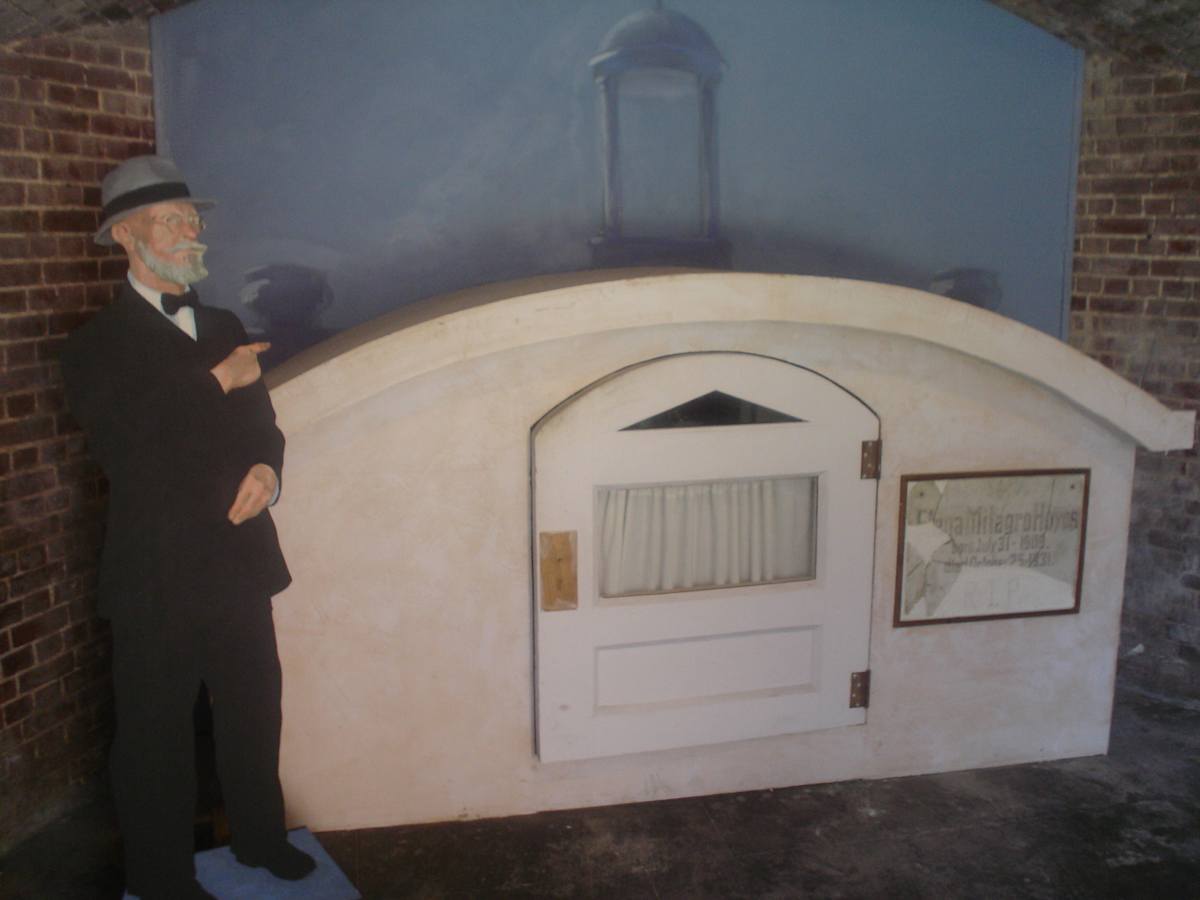
I left Key West in 1941, my heart shattered but my conviction unbroken. As I departed, an explosion destroyed the mausoleum I had built for Elena, a final act of defiance against a world that had never understood our love. I like to think it was Elena herself who orchestrated that destruction, ensuring that no one else could ever claim the space that had once been sacred to us alone.
I am old now, and my time in this world grows short. But I do not fear death. I welcome it, for I know that Elena waits for me on the other side, her dark hair cascading over her shoulders, a red rose behind her ear, her arms open to receive me at last.
They called me a madman, a monster, a criminal. But I know the truth. I am simply a man who loved too much and too well, a man who refused to let death have the final word. And when I close my eyes for the last time, I will do so with Elena's name on my lips and the certainty of our eternal reunion in my heart.
Our love story does not end here.